
additiv AG
AI-Powered Sales Intelligence for Insurance Advisors
Industry
Fintech / InsurTech
All client information in one place
What an advisor knows about their clients is the foundation of personal advice. The Insurance Advisor Assistant combines this knowledge with a personal assistant that can be operated simply by voice. Spoken notes, existing client information and possible next steps become part of one connected workflow.
At the center is not a collection of individual AI tools, but the combination of simple input, central client intelligence and concrete support for the advisor: recognizing relevant developments, deriving Next Best Actions and preparing meetings as well as personal communication.
Starting point
Personal advice lives on context. A family event, a job change or an expiring contract can matter more for the next conversation than any master data entry. In day-to-day advisory work this knowledge is created constantly, yet CRM systems often stay empty while the actual client knowledge sits in the advisor's head.
Advisors are only human: with hundreds of clients, nobody remembers everything. The challenge is capturing knowledge easily, keeping it assigned to the client and their history, and bringing it back into preparation at the right time.
Solution
The Advisor Assistant gives the advisor a personal assistant that can simply be operated by voice. New information is spoken after the conversation instead of being translated into individual fields, and the entire client intelligence lives in one place.
This creates a sales and operations superpower: the advisor sees optimization potential instantly, forgets nothing, segments the client base with precision and makes every client more relevant offers. The assistant replaces neither the client relationship nor professional responsibility: review and decisions stay with the human.
Simply speak what matters
New information is created in conversation. Afterwards, the advisor can capture it as a short voice note and assign it to the client, instead of first translating it into fields and tasks themselves. The application transcribes and analyzes the content: what was said becomes a summary, relevant life events and suggestions for next steps.
The decisive difference: the information does not stay in an audio file or unstructured text, but becomes usable client context.
Client context stays together
Master data alone does not tell the story of a client relationship. Only together with notes, relevant events, insurance information and previous action suggestions does the context emerge that personal preparation needs. The application bundles this information and makes it available to the assistant.
The advisor no longer has to re-describe the existing context for every task: what is known about the client, what has changed, what should be considered before the next conversation? That is exactly what the central client intelligence answers.
Recognize what matters next
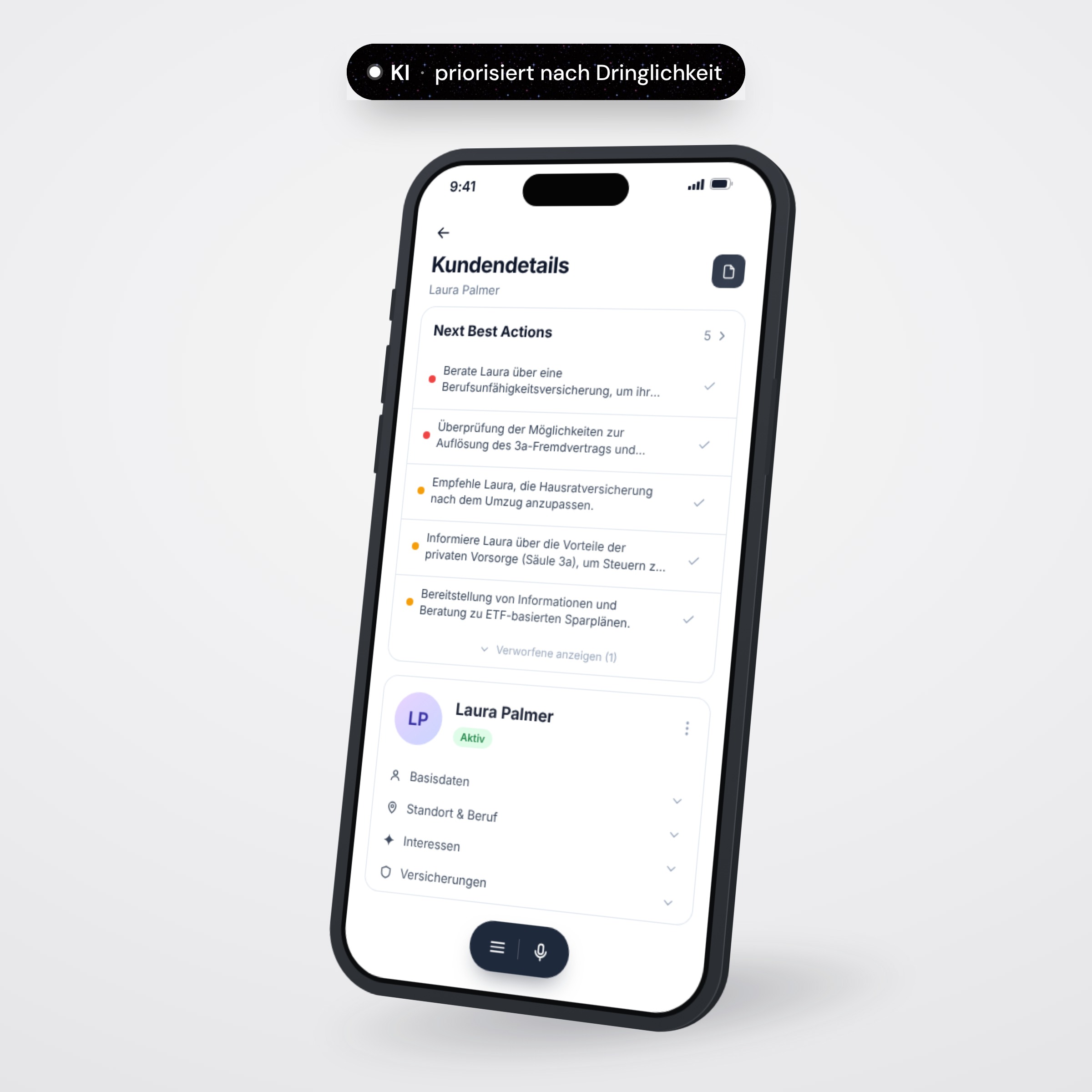
A new life situation can be the occasion for a conversation. An open question can require preparation. Next Best Actions make such possibilities visible, building on newly captured information and the existing client context.
Every Next Best Action is decision support, not a finished answer: the advisor decides which suggestions to pick up and how to discuss them with the client. That is how knowledge about the client turns into a concrete next step.
Prepare meetings and next steps
Based on the existing client context, the assistant supports preparation: from conversation content to personal messages via email or WhatsApp, through to selected document drafts such as quotes, comparisons or claims texts. The stored formal or informal address preference feeds into the wording.
Every draft is a starting point for review, not an automated send-out: a generated document is neither a binding quote nor a submitted claim. That is how client information is not just documented, but made usable for the next action.
Advisory occasions visible across the book
The segmentation view complements the individual client perspective with an overview of the entire client base. A matrix connects life stages with defined advisory occasions, such as family, a longer gap in contact or expiring external contracts.
This makes relevant groups and possible contact occasions visible, without anything slipping through. The assignment follows transparent rules; it is a supporting function of the client intelligence, not an AI purchase prediction.
AI for speech and text, classic logic for rules
Under the hood, the application works with a clear division of labour: audio recordings are transcribed, the analysis derives summaries, life events and options for action, and the client-related assistant receives the information from the system as the basis for its answers. Classic software logic handles data management, status tracking and segmentation rules.
The web application is built with React and TypeScript on the frontend and Express and PostgreSQL on the backend, with HeyGen for avatar functions. More important than the list of components is how they connect: a simple input is linked with stored client context and becomes usable in the interface as information, a suggestion or a draft.